
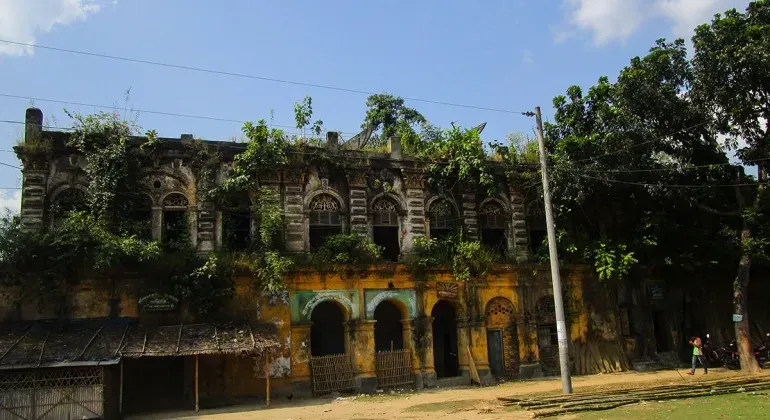
Haripur Rajbari stands as a witness of time in the center of Haripur upazila of Thakurgaon district. Ghan Shyam Kund's descendant Raghvendra Roy Chowdhury laid the foundation stone of the Haripur zamindar house built in 1893, but later his son Jagendra Narayan Roy Chowdhury completed the work of the zamindar house.
It is said that in 1400 Ghan Shyam Kund Andi came to Haripur for cloth business. At that time a Muslim widow named Meherunnessa was the landlord of the area. When some of Mehrunnesa's zamindaris were auctioned due to non-payment of rent, Ghan Shyam Kund bought them. Jagendra Narayan Roy, son of Raghavendra Roy, a descendant of Ghan Shyam Kund, started work on the Haripur Rajbari in the late nineteenth century. Jagendra Narayan Roy was awarded the title of Rajarshi by the British Government for various philanthropic works.
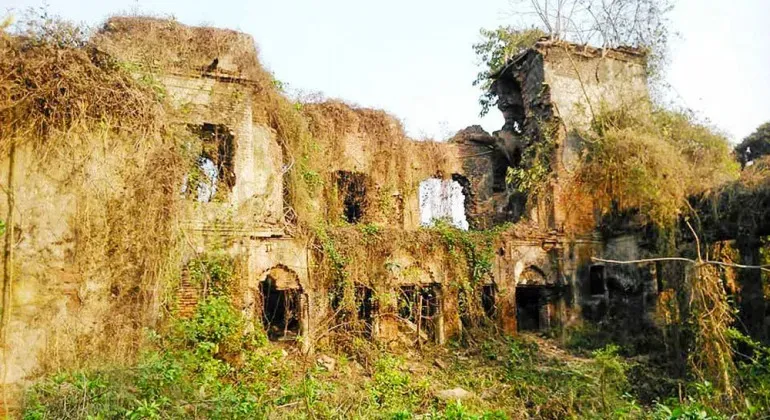
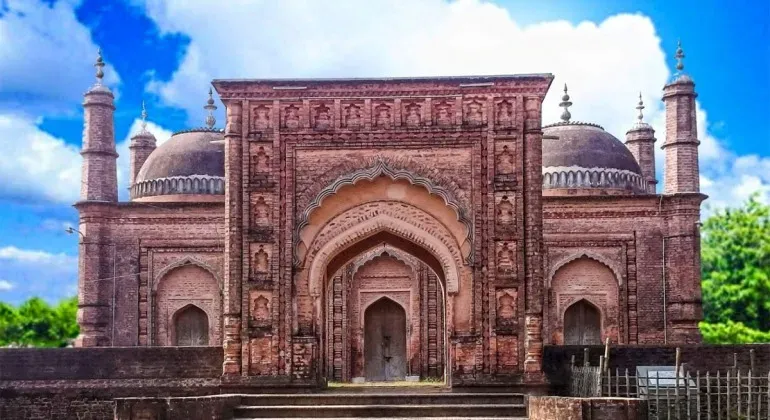
More than a century old Haripur Rajbari has many ancient artifacts in its beautiful craftsmanship. Fourteen busts of Rajarshi Jagendra Narayan are on the east wall of this two-storied zamindar house designed with vine leaves. On the eastern side is a 400-year-old terracotta temple of Shiva and Nat. In 1900, due to the division of the descendants of Ghanshyam, the Haripur Rajbari was divided into two parts as the big side Rajbari and the small side Rajbari. At present, various rooms of the abandoned Haripur Rajbari are used as offices of various organizations including the local women's association, land officers' association.

 ColoZai